Geography is the foundation
Every unit starts with a place — a river, a mountain pass, a port. Students learn to read landscapes the way a geographer does, before they read a single date.
Eight Themes, Four Civilizations, One Year of Discovery
An elementary social-studies framework that helps students explore geography, trade, innovation, cities, and interconnected civilizations through systems-thinking and global learning. Public School Edition. Elementary Grades 4–5.
In How the World Works, fourth- and fifth-graders investigate how societies connect, adapt, innovate, and exchange ideas across regions and time — the way historians and geographers actually think.
Every unit starts with a place — a river, a mountain pass, a port. Students learn to read landscapes the way a geographer does, before they read a single date.
Trade routes, water systems, knowledge networks, design traditions. Students see how cities, ideas, and goods move — and what happens when they meet.
Four civilizations are studied side-by-side across eight themes, so a fifth-grader can compare how Mali traded gold and how Malacca traded spices — in the same week.
The curriculum examines historical civilizations through geography, trade, innovation, governance, and cultural systems. It does not promote religious belief or religious practice.
Each civilization is studied as a system of geography, trade, water, and ideas — not as a date list. The four are deliberately spread across continents and centuries so students see global patterns, not regional snapshots.
A meeting-place of classical Mediterranean and North African knowledge. Students explore Cordoba's library, Granada's irrigation engineering, and how a translation movement carried ideas into medieval Europe.
A gold-and-salt trade empire built on the Niger River. Students follow caravans across the Sahara, examine Timbuktu's manuscript libraries, and see how a continental-scale literacy economy worked.
A maritime port city at the chokepoint between the Indian Ocean and the South China Sea. Students learn how monsoon winds, multilingual mercantile law, and a single strait shaped global commerce.
A highland civilization that minted its own coinage, built towering stone stelae, and connected the Red Sea to inland Africa. Students explore highland terrace agriculture and long-distance trade.
Each thematic unit contains four chapters — one per civilization — so students draw direct comparisons every week. By year-end, a fifth-grader can explain how four very different places solved similar problems.
Geography — reading the landscape
Trade routes and movement
Urban systems and daily life
Agriculture and hydrology
How knowledge moves between places
Astronomy and counting the world
Craft, materials, and what people made
Legacy and what we still see today
A coordinated three-book set for the elementary classroom. The Student Textbook carries the narrative, the Explorer's Journal carries the practice, and the Teacher Manual makes both teachable on Monday morning.
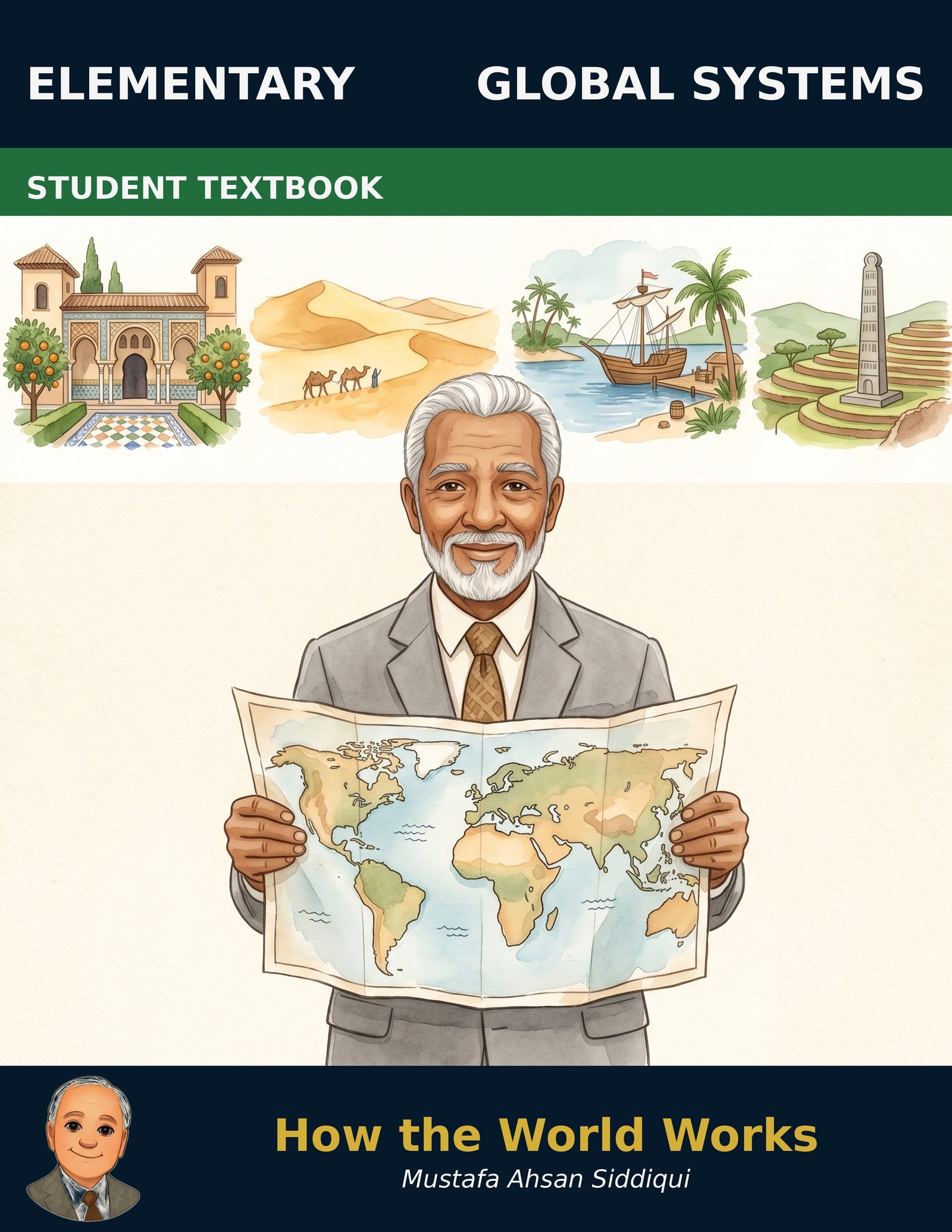
The narrative spine. Each chapter is short enough to read in one sitting, fully illustrated, and structured around inquiry questions students return to throughout the unit.
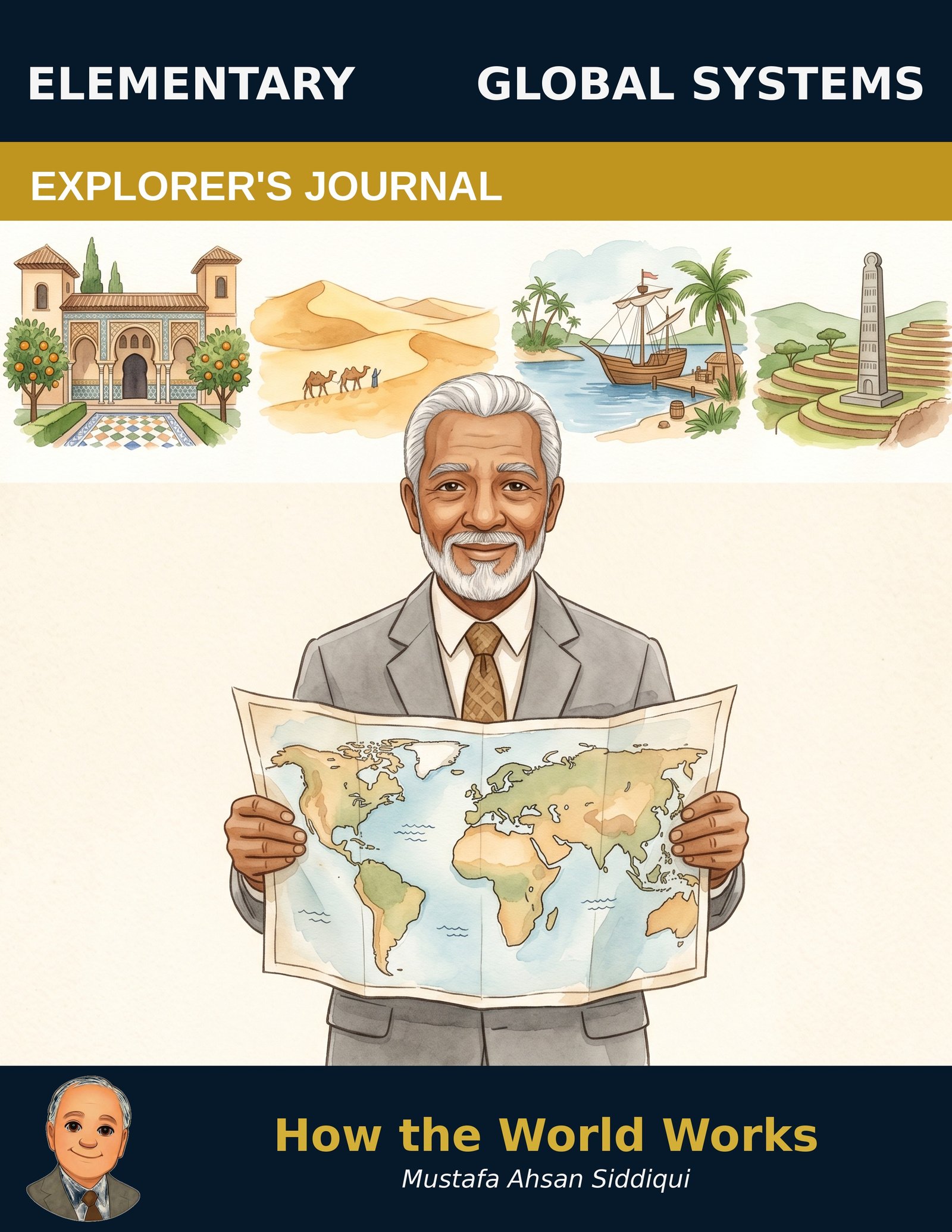
Where students do the thinking on the page. Compare-the-four activities, sketch maps, vocabulary work, comprehension checks, and a year-end project bank.
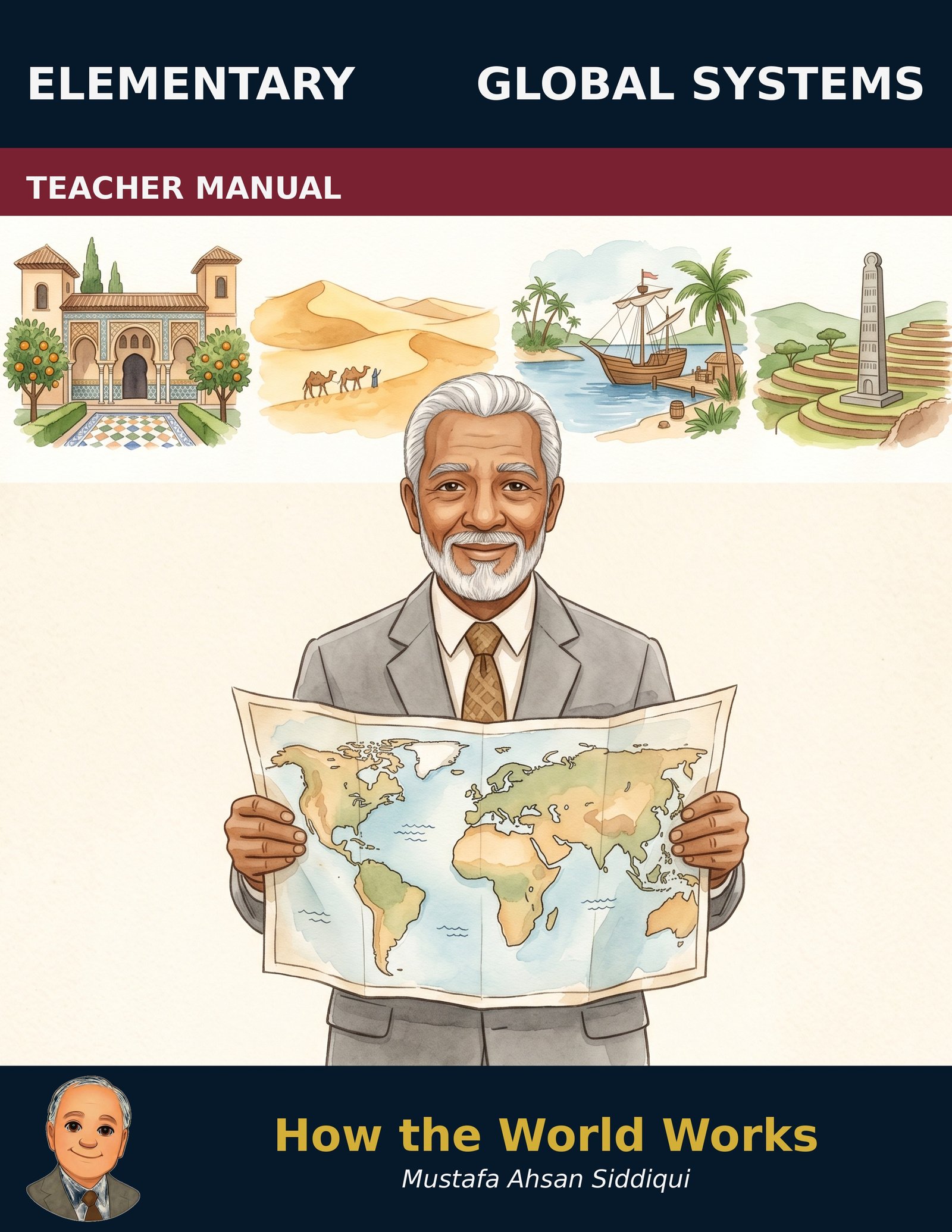
Lesson-by-lesson pacing, discussion prompts, hands-on activities, answer keys, cross-chapter connections, and a year calendar. Built so a teacher can open the book on Monday morning and teach.
Inquiry-based learning, systems-thinking, and interdisciplinary connections — written and paced for what fourth- and fifth-graders are ready to do.
We are currently in conversation with educators and schools interested in inquiry-driven global learning experiences. The Elementary Grades 4–5 framework is shipping; Middle and High School tiers are in development.
Pilot partners receive direct implementation support, classroom feedback channels, and early access to Middle and High School materials as they release.
Request a Pilot ConversationOpen to public schools, charter schools, Islamic schools, homeschool families, and co-ops — any setting committed to inquiry-driven elementary learning.

This curriculum examines historical civilizations through geography, trade, innovation, governance, and cultural systems. It does not promote religious belief or religious practice.